Jack was kidnapped by Dr. Mackie
Young Captain Jack · The Son of a SoldierJack's abduction is the moment when Dr. Mackey's disputed claim to fatherhood becomes an instrument of force. Jack has refused to accept the surgeon's assertion that he is his son, and Dr. Mackey responds not with proof but with seizure: soldiers are ordered to take Jack away, silence him, and hold him in confinement. The abduction therefore advances both the immediate adventure plot and the larger struggle over Jack's identity, separating him from the Ruthven household while the truth about his origins remains contested.
Causes and Background
The conflict grows out of the competing accounts of Jack's past. Jack has been raised by the Ruthven family after being found as a small child with his injured mother following a storm and shipwreck. His fragmentary memory preserves only an uncertain impression of violent waves, while the physical and narrative clues surrounding him include a wedding ring kept by Mrs. Ruthven and the wreck itself. Marion Ruthven has already told him that Martin and Alice Ruthven adopted him when he was three or four, and that he is their son in the familial sense even though he was not born to them. At the same time, Dr. Mackey arrives claiming, "Jack, I am your father!" The declaration threatens to replace the stable identity Jack has known with a new version controlled by the doctor.
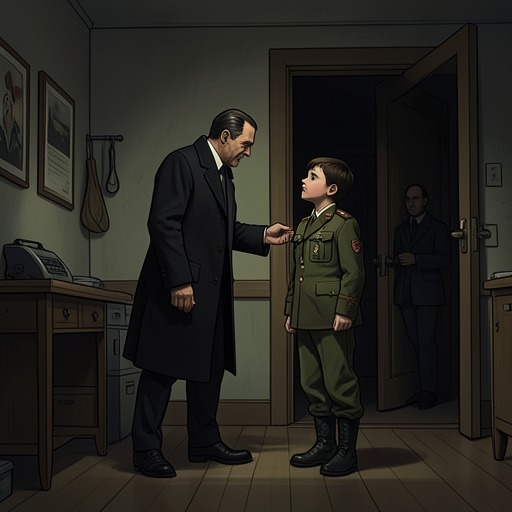
Jack's resistance is especially important because he does not merely express confusion; he openly rejects the doctor's authority. Dr. Mackey's anger turns into cunning, and he promises to make Jack suffer before calling for assistance. The scene thus reveals the difference between the two men's positions. Jack demands recognition on the basis of truth, while Dr. Mackey treats power over Jack's body as a substitute for legal or familial proof. The abduction begins when that substitution is made explicit.
What Happens
Dr. Mackey orders two Confederate soldiers to conduct Jack to their camp and ensure that he does not escape. Jack protests that he must not be taken from home and identifies Dr. Mackey as a fraud, but the soldiers overpower him. He struggles to free himself, yet their physical strength prevails, and he becomes their prisoner. Pete Gendron, the guerrilla associated with Dr. Mackey, reinforces the doctor's position by insisting that Dr. Mackey is trustworthy, turning the seizure into a coordinated act rather than an isolated outburst.
The destination is changed almost immediately. Dr. Mackey instructs the soldiers to take Jack to the Old Red House up the river, a place they know. The order gives the abduction a concealed, controlled geography: Jack is not simply escorted away in public but led across the plantation by a back route. When he tries to cry out, one soldier levels a gun and commands him to remain silent. The route, the weapon, and the soldiers' authority strip him of the ordinary protections of home and public witness.
The episode later becomes a more severe imprisonment. Jack finds himself in a small cabin high on the mountainside, with his hands tightly bound behind him and fastened to a heavy wooden stake driven into the hard mud floor. The Confederates have left him, night has passed, and another night is approaching. He is thirsty and hungry as well as physically restrained. The details make the abduction a sustained condition of captivity rather than a brief removal: isolation, deprivation, and the threat of armed supervision all work together to prevent escape.
The Abduction and the Identity Mystery
Jack's seizure is inseparable from the novel's recurring contest over names and parentage. Before the abduction, he has been told that he is not truly a Ruthven and might one day have to leave. Marion counters that he is John Ruthven, her brother, because the family adopted him. Dr. Mackey then offers a rival explanation by presenting himself as Jack's biological father. The physical capture gives the doctor temporary control over which account can govern Jack's life.
Yet the abduction also exposes the weakness of Dr. Mackey's claim. A genuine father-son recognition would ordinarily depend on memory, testimony, family history, or material evidence; Dr. Mackey instead relies on soldiers and confinement. His conduct suggests that he needs Jack removed before other witnesses can speak and before the story of the shipwreck, the ring, and Jack's childhood can be examined. The episode consequently makes coercion itself evidence of the doctor's fraudulent purpose, even before the later revelation that Jack is Colonel Stanton's son.
The spatial movement reinforces this struggle. Jack is taken from a plantation that has served as his home and from a family that has given him social belonging, then pushed into the Old Red House and finally into a mountain cabin where the doctor's authority is enforced through military intermediaries. Each transfer narrows Jack's freedom and visibility. The spaces function as stages in the attempted rewriting of his identity: home represents adopted kinship, the hidden route represents concealment, and the cabin represents the imposed status of a prisoner.
Consequences and Aftermath
The immediate consequence is the destruction of Jack's physical security. He is no longer a young man arguing with an adult authority on familiar ground; he is an armed group's prisoner, deprived of food, water, movement, and the ability to summon help. His imprisonment raises the stakes of the family mystery because escape is now necessary before the question of his parentage can even be heard fairly.
The abduction also reveals a criminal partnership. While the soldiers take Jack away, Dr. Mackey remains behind to tend Gendron's wound and discuss their plans. He tells Gendron to stand by him, showing that the capture is part of a broader alliance rather than an impulsive act. Jack's removal leaves the conspirators free to continue operating while he is hidden and unable to challenge their narrative.
The later testimony of Colonel Stanton gives the abduction its full meaning. Colonel Stanton explains that Dr. Mackey had previously obtained details of his family and property while he was vulnerable in an insane asylum, then drugged him and disappeared. The property at stake included an English inheritance for the colonel and a Virginia estate belonging to his wife, Laura Stanton. Against this background, Jack's capture appears as an attempt to control the living heir whose identity could expose Dr. Mackey's scheme. The final disclosure that Jack is Colonel Stanton's son changes the episode from an apparent quarrel over adoption into an effort to suppress the rightful family connection.
Narrative Significance
The event converts secrecy into action. Earlier revelations unsettle Jack through rumor, childhood recollection, and objects whose meanings are not yet clear; the abduction makes the uncertainty bodily and immediate. Jack's freedom shifts from secure to threatened, while Dr. Mackey's public claim to be a father is exposed as a method of domination. The episode's decisive irony is that the man who claims the closest biological relationship to Jack behaves as his captor, whereas the Ruthven family, whose relationship began through adoption, remains the source of Jack's home and protection.
As a plot mechanism, the abduction also delays ordinary proof while intensifying the demand for it. Jack cannot settle his identity by argument alone because the opposing claimant controls armed men and hidden locations. His captivity forces the story to move through rescue, testimony, and corroborating evidence before the competing versions of his parentage can be resolved. When Jack is finally identified as Colonel Stanton's son, the abduction is retrospectively understood as the central coercive act in Dr. Mackey's attempt to prevent that truth from becoming socially and legally effective.